Top 5 Machine Guarding Strategies to Enhance Safety in Food Production Plants
The food production floor is a high-stakes environment. Between high-speed conveyors, industrial mixers, and automated slicers, the potential for injury is a constant reality. However, food and beverage manufacturers face a unique challenge that heavy manufacturing does not: hygiene. You cannot simply bolt a standard metal cage around a machine and call it a day; if that guard traps food particles or bacteria, you trade a safety hazard for a contamination risk.
Balancing rigorous safety standards with strict sanitation requirements requires a strategic approach. To help you navigate this complex landscape, we have compiled the top five machine guarding strategies specifically tailored for the food production industry.
1. Prioritize Hygienic Design Principles
In food processing, the “cleanability” of a machine guard is just as important as its strength. A guard that prevents an amputation but causes a Listeria outbreak is a failure. Your guarding strategy must align with Sanitary Design Principles.
When selecting or fabricating guards, consider the following:
- Material Selection: utilize corrosion-resistant materials, typically 316-grade stainless steel, which can withstand harsh washdown chemicals.
- Sloped Surfaces: Ensure all horizontal surfaces are sloped to prevent water pooling and bacterial growth.
- Eliminate Crevices: Avoid piano hinges or drilled holes that can trap food debris. Opt for open-mesh designs or clear polycarbonate that is easy to spray down.
- Stand-offs: Use spacers to mount guards slightly away from the machine frame, allowing water and cleaning agents to flush out the space behind the guard.
2. Conduct a Lifecycle Risk Assessment
Many facilities make the mistake of assessing risk only during normal operation. However, accidents often occur during non-standard modes of operation, such as unjamming a conveyor, sanitation shifts, or maintenance setup.
A comprehensive strategy involves a Lifecycle Risk Assessment. This maps out every human interaction with the machine:
- Operation: Standard running conditions.
- Sanitation: How do cleaners access internal zones? Do they need to remove guards?
- Maintenance: Is there safe access for lubrication and belt changes without full disassembly?
By understanding these different phases, you can design guards that are modular or hinged, allowing necessary access without encouraging employees to bypass safety measures completely.
3. Implement Smart Interlocking Devices
In the age of Industry 4.0, physical barriers should be augmented with intelligent technology. Interlocks ensure that if a guard door is opened, the hazardous motion stops immediately. However, in food plants, standard mechanical keys can become clog points for flour, grease, or meat products.
The Strategy: Upgrade to non-contact, RFID-coded safety switches or IP69K-rated magnetic interlocks. These devices offer several benefits:
- Hygiene: They have smooth surfaces with no keyholes to trap contaminants.
- Water Resistance: They are designed to withstand high-pressure, high-temperature washdowns (IP69K rating).
- Anti-Tamper: Coded RFID makes it significantly harder for operators to bypass the switch using a spare magnet or tape.
4. Ensure Visibility for Production and Safety
A common complaint from operators is that solid guarding obscures their view of the product flow. If an operator cannot see a jam forming because of a metal mesh guard, they are more likely to remove the guard to do their job properly. This creates a culture of bypassing safety.
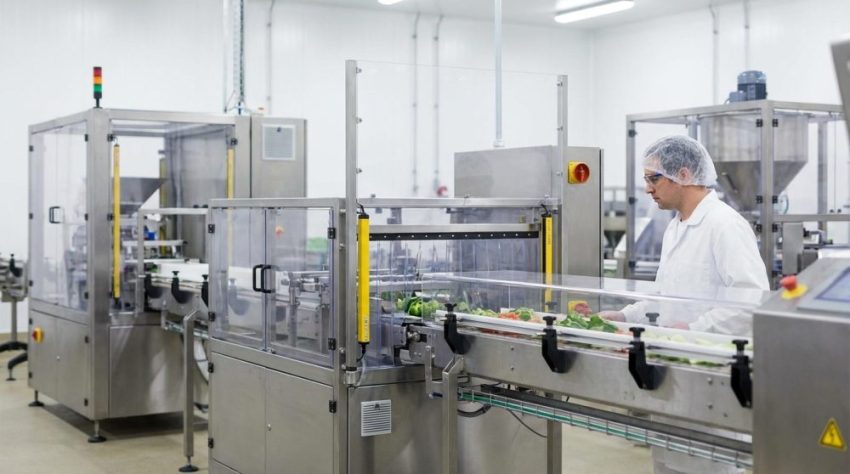
To combat this, utilize transparent guarding materials like optically clear polycarbonate or scratch-resistant acrylics where appropriate. This strategy serves a dual purpose:
- It allows operators to monitor quality and flow without breaching the safety zone.
- It allows safety managers to visually inspect the internal components of the machine for cleanliness without dismantling the setup.
5. Standardize Lockout/Tagout (LOTO) Integration
Machine guarding is the first line of defense, but it must work seamlessly with your Lockout/Tagout (LOTO) procedures. A guard that is difficult to remove for maintenance will inevitably lead to frustration and unsafe workarounds.
Strategic integration involves:
- Designing guards with captive screws so that fasteners aren’t lost (and don’t fall into the food) during removal.
- Placing LOTO isolation points outside the guarded area so power can be cut before a guard is ever opened.
- Using “trap key” systems where the key to open the guard door is trapped in the power isolator until the machine is turned off.
Conclusion
Enhancing safety in a food production plant is a balancing act between protecting people and protecting the product. By focusing on hygienic design, leveraging smart technology, and acknowledging the reality of how operators interact with machines, you can create a facility that is both safe and efficient.
Remember: Machine guarding is not a one-time installation; it is an ongoing strategy. Review your guards regularly, listen to operator feedback, and ensure your safety measures evolve alongside your production needs.