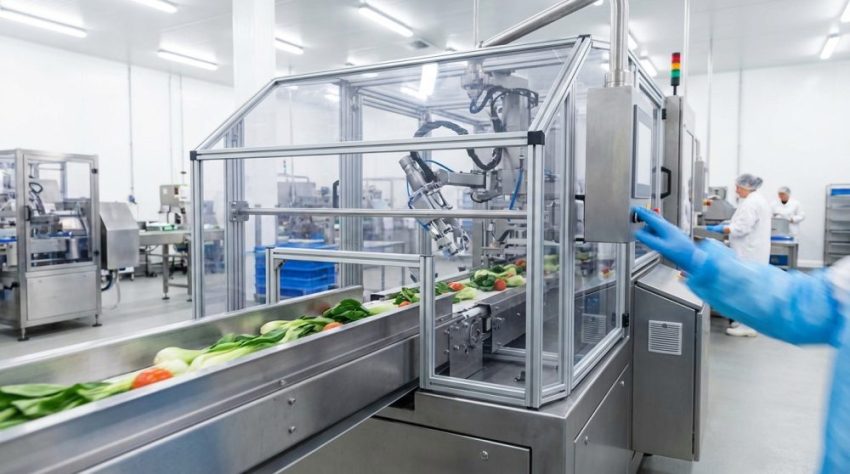
Innovations in Machine Guarding: Balancing Productivity and Safety in Food Processing
In the high-stakes world of food processing, facility managers have historically faced a difficult dichotomy: speed versus safety. On one side, tight margins and high demand require production lines to run at breakneck speeds. On the other, the industry faces strict regulatory scrutiny regarding worker safety and food hygiene.
For decades, machine guarding was seen as a necessary evil—clunky cages and barriers that kept workers safe but made maintenance and sanitation a nightmare. However, the narrative is changing. Thanks to the Fourth Industrial Revolution (Industry 4.0), a new wave of innovations in machine guarding is proving that you don’t have to sacrifice throughput to ensure safety. In fact, modern safety solutions are becoming key drivers of productivity.
The Unique Challenge: The Washdown Environment
Unlike automotive or textile manufacturing, food processing presents a unique hurdle: sanitation. A machine guard cannot simply prevent a hand from entering a danger zone; it must also withstand high-pressure, high-temperature chemical washdowns without becoming a breeding ground for bacteria like Listeria or Salmonella.
Traditional guarding often trapped food particles in crevices, requiring extensive downtime to disassemble and clean. Today’s innovations are solving this via Hygienic Design.
Top Innovations Transforming the Floor
1. IP69K-Rated Hygienic Guarding
The gold standard for food safety is the IP69K rating, which certifies that equipment can withstand high-pressure, high-temperature washdowns. Modern guarding systems now utilize:
- Open-profile designs: Eliminating closed tubing where bacteria can hide.
- Sloped surfaces: Ensuring water and debris run off naturally rather than pooling.
- Stand-off mounting: Spacing guards away from the machine frame to allow for 360-degree cleaning without disassembly.
The Productivity Gain: Sanitation teams can clean faster and more effectively, significantly reducing the downtime required for changeovers.
2. RFID and Non-Contact Interlocks
Mechanical keys and tongue switches are prone to breakage and can be difficult to clean. The industry is rapidly shifting toward RFID-coded non-contact switches. These sensors allow doors to be misaligned (common in heavy use) while still functioning, and they are fully sealed against moisture.
Furthermore, high-level coding prevents operators from tampering with or bypassing safety switches—a common, dangerous practice used to keep lines running during minor jams.
3. Advanced Vision Systems and AI
Perhaps the most futuristic leap is the move from physical barriers to “virtual” guarding. Advanced camera systems and Artificial Intelligence (AI) can now monitor safety zones in real-time.
Instead of hard-stopping a machine the moment a human approaches (which necessitates a long restart process), these systems can trigger Safe Speed Monitor modes. The machine slows down to a safe operating speed when a worker approaches and resumes full speed automatically when they leave.
4. Rapid-Roll Automated Doors
In areas where physical barriers are required for contamination control (separating raw from cooked zones) or hazard containment, automated rapid-roll doors are replacing static gates. These doors offer:
- High speeds: Opening and closing in seconds to minimize cycle interruption.
- Safety edges: Reversing immediately if an obstruction is detected.
- Washdown capabilities: Made of FDA-compliant PVC or stainless steel mesh.
How Safety Drives ROI
Implementing these advanced guarding technologies requires an upfront capital investment, but the Return on Investment (ROI) is tangible. By integrating safety into the automation process, processors unlock several benefits:
Reduced Unplanned Downtime: Intelligent diagnostics in modern safety PLCs tell operators exactly which door is open or which sensor is faulted, eliminating the “hunting” time during a stoppage.
Brand Protection: Hygienic guarding reduces the risk of foreign material contamination and pathogen growth, protecting the brand from costly recalls.
Workforce Retention: In a tight labor market, a visibly safe and modern workplace helps attract and retain skilled talent who want to work with cutting-edge technology rather than dangerous legacy equipment.
Conclusion: The Future is Integrated
The days of bolting a piece of Plexiglas to a conveyor and calling it “safe” are over. In the modern food processing facility, machine guarding is a sophisticated, integrated component of the production line.
By embracing innovations like hygienic design, RFID interlocks, and AI-driven monitoring, manufacturers are finally solving the paradox. They are proving that the safest plant is, quite often, also the most productive one.