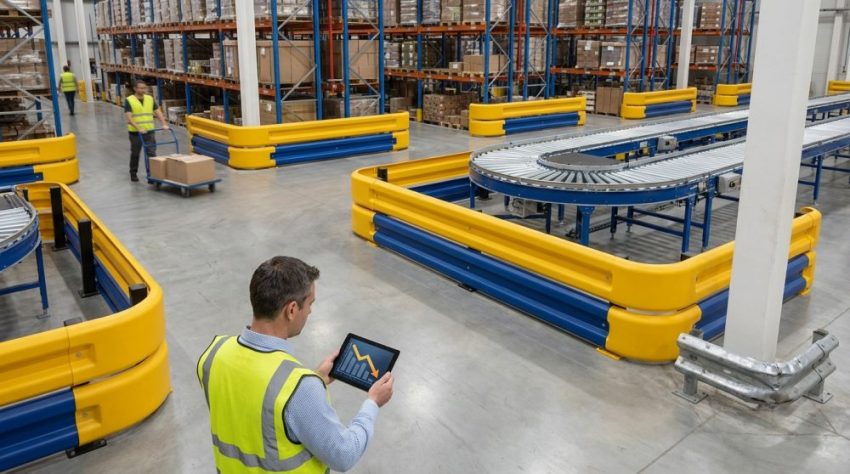
How Polymer Barrier Systems Reduce Maintenance Costs in Logistics Facilities
In the high-octane environment of a modern logistics facility, impacts are not a matter of “if,” but “when.” Forklifts zip around corners, pallet jacks maneuver through tight aisles, and heavy goods are constantly in motion. For decades, the industry standard for protecting people and infrastructure has been steel. However, facility managers are increasingly discovering that while steel provides protection, it comes with a hefty, recurring price tag: maintenance.
Enter the era of flexible polymer barrier systems. While they often look sleek and modern, their true value lies in the bottom line. In this post, we will explore how making the switch from rigid steel to flexible polymer can drastically reduce your long-term maintenance costs and improve your facility’s Total Cost of Ownership (TCO).
The Physics of Impact: Deflection vs. Deformation
To understand the cost savings, you first have to understand the physics. Traditional steel barriers are rigid. When a 5-ton forklift hits a steel guardrail, the energy of that impact has nowhere to go. The steel absorbs the energy by deforming (denting, buckling, or crumpling). Once steel is deformed, its structural integrity is compromised. It cannot “heal” itself.
The result? You have to replace the barrier section immediately to remain compliant with safety standards. This means ordering parts, scheduling maintenance crews, and shutting down that section of the warehouse.
Polymer barriers, on the other hand, are designed with scientific memory. When hit, they flex to absorb the energy and then reform to their original shape. Because the barrier survives the impact, there are no immediate replacement costs and no maintenance call-outs.
1. Saving Your Slab: Eliminating Floor Repairs
One of the most expensive hidden costs of steel barriers is the damage they do to concrete floors. Because steel is rigid, the shock of an impact travels down the post and directly into the floor fixings.
A severe impact can rip anchors right out of the ground, causing the concrete to crack or spall. This creates a “double whammy” for maintenance budgets:
- You have to replace the steel barrier.
- You have to repair the concrete floor (which often requires specialized epoxy and curing time) before you can install the new barrier.
Polymer barriers are designed to dissipate impact energy throughout the material rather than transferring it all to the floor. This protects your floor anchors and leaves your concrete slab intact, saving you thousands in specialized masonry repairs over the facility’s lifespan.
2. Goodbye to Rust and Repainting
Logistics facilities can be harsh environments. Humidity, wash-downs, and general wear and tear take a toll on metal. Steel barriers are prone to rust and corrosion, especially if the paint is scratched during minor impacts.
To maintain a professional and safe appearance, steel barriers require a strict regimen of sanding, priming, and repainting. This is labor-intensive and requires buying consumables.
Polymer barriers offer a maintenance-free aesthetic solution:
- Self-Colored: The high-visibility yellow (or other safety colors) is inherent to the material, not a surface coat. A scratch on a polymer barrier is the same color as the surface.
- Corrosion Proof: Polymer does not rust, rot, or corrode. It is impervious to water and most chemicals.
- UV Resistant: High-quality polymers are UV stabilized, meaning they won’t fade or become brittle in sunlight near loading docks.
3. Reduced Wear and Tear on Material Handling Equipment (MHE)
When a forklift hits a steel wall, the forklift stops dead. The impact force that crumples the steel rail also travels back into the vehicle. This can damage the forklift’s bodywork, shatter lights, jolt the battery, or injure the driver.
Because polymer barriers flex on impact, they offer a “soft landing.” They absorb the blow progressively, cushioning the impact for the vehicle. While the primary goal is safety, the secondary benefit is a reduction in repair costs for your forklift fleet and a reduction in downtime for your equipment.
4. Minimizing Operational Downtime
Maintenance costs aren’t just about the price of a replacement bolt or a bucket of paint; the biggest cost is often downtime.
Every time a steel barrier needs replacing or a floor needs repairing, you have to cordon off an aisle. This disrupts the flow of goods, slows down picking rates, and reduces overall efficiency. By installing polymer systems that can withstand repeated impacts without needing repair, you keep your facility running at 100% capacity.
Conclusion: A Smart Investment for the Long Haul
When looking strictly at the upfront purchase price, polymer barrier systems can sometimes appear more expensive than basic steel guardrails. However, this is a classic case of “sticker price” vs. “actual cost.”
When you factor in the elimination of repainting, the reduction in floor repairs, the longevity of the barriers, and the preservation of your vehicle fleet, the Return on Investment (ROI) for polymer becomes undeniable. By switching to polymer, you aren’t just buying a safety product; you are investing in a maintenance-free future for your logistics facility.
Ready to stop repairing and start saving? Evaluate your facility’s high-impact zones today and consider where polymer protection could improve your bottom line.