Bollards vs. Guardrails: Which Safety Solutions Does Your Facility Actually Need?
In the high-stakes environment of industrial facilities, warehouses, and commercial parking lots, safety isn’t just a checkbox—it is the backbone of operation. Every year, facility managers face the daunting task of mitigating risks involving forklifts, delivery trucks, and pedestrian traffic. While the goal is zero accidents, the method of getting there often causes confusion.
When it comes to physical barriers, two heavyweights dominate the conversation: bollards and guardrails. While they both serve the ultimate purpose of protection, they are not interchangeable tools. Choosing the wrong one can lead to wasted budget, damaged assets, or, worst of all, injury.
So, how do you decide? Let’s break down the distinct roles of these safety sentinels to help you determine which solution your facility actually needs.
The Bollard: Precision Protection and Accessibility
Bollards are the vertical posts you often see guarding storefronts, gas pumps, and warehouse corners. They are designed to be sturdy, highly visible, and capable of stopping a vehicle in its tracks.
When to Use Bollards
Think of bollards as your facility’s “Secret Service” agents—they provide close-protection for specific, high-value targets without completely blocking movement.
- Protecting Specific Assets: If you have a singular vulnerability, such as an electrical box, a fire hydrant, or a corner of a building that trucks keep clipping, a bollard is the perfect solution.
- Doorway Protection: Overhead door tracks are notoriously prone to forklift damage. A pair of bollards installed on either side of the doorframe provides a robust shield while leaving the entrance wide open for traffic.
- Filtering Traffic: One of the bollard’s superpowers is permeability. You can space them to block vehicles while allowing pedestrians, wheelchairs, or pallet jacks to pass through freely.
The Pros of Bollards
- Space Efficient: They take up a very small footprint compared to rails.
- Versatile Aesthetics: From heavy-duty steel pipe to architectural stainless steel covers, they can fit industrial or customer-facing environments.
- 360-Degree Strength: A round bollard deflects impact away from the center regardless of the angle of approach.
The Guardrail: Perimeter Defense and Segregation
If bollards are the Secret Service, guardrails are the fortress walls. These horizontal barriers are engineered to absorb high-impact collisions and guide errant vehicles back to their lanes. They create a continuous physical line that visually and physically screams, “Do Not Cross.”
When to Use Guardrails
Guardrails are best utilized when you need to define boundaries or protect long stretches of space.
- Separating Traffic Streams: In a busy warehouse, keeping forklifts away from pedestrian walkways is critical. A continuous guardrail creates a safe “sidewalk” that ensures human traffic and heavy machinery never meet.
- Protecting Racking Rows: If you have long aisles of pallet racking, a guardrail running the length of the aisle (or at the end-caps) prevents forklifts from undercutting and collapsing the shelves.
- Wall and Mezzanine Protection: For facilities with vehicular traffic running parallel to office walls or expensive machinery, guardrails act as a bumper, absorbing the shock of a sideswipe.
The Pros of Guardrails
- Continuous Coverage: There are no gaps for a fork tine or a small vehicle to slip through.
- High Visibility: The length of the rail creates a massive visual deterrent for drivers.
- Impact Distribution: Good guardrails are designed to flex and distribute the energy of a crash across multiple posts, minimizing damage to the floor.
The Showdown: How to Choose
Still on the fence? Use this quick decision matrix to guide your purchase:
1. What is the nature of the hazard?
- If it is a point hazard (like a utility meter or a building corner), choose Bollards.
- If it is a linear hazard (like a pedestrian walkway or a long wall), choose Guardrails.
2. How much space do you have?
- If space is tight and every inch of floor area counts, Bollards offer protection with a minimal footprint.
- If you have room to establish dedicated lanes, Guardrails provide superior boundary definition.
3. Do people need to walk through it?
- If yes, Bollards allow flow.
- If no, and you want to prevent crossing entirely, Guardrails are the answer.
The Hybrid Approach: Better Together
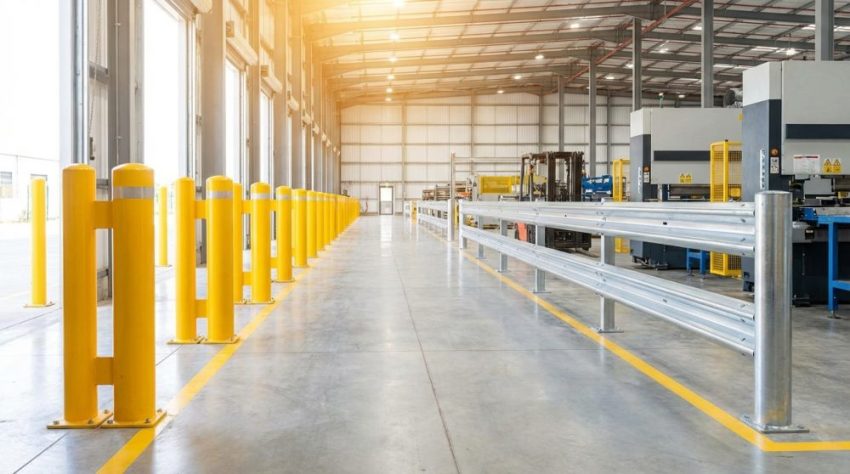
The truth is, most efficient facilities utilize a strategic mix of both. You might see a guardrail separating a forklift lane from a pedestrian path, but that path might terminate at a doorway protected by two bollards.
By understanding the unique strengths of each barrier, you can create a safety ecosystem that doesn’t just meet OSHA standards—it actively prevents downtime and saves lives.
Conclusion
Investing in safety infrastructure is never a cost; it is an investment in continuity. Whether you opt for the precision of a bollard or the perimeter defense of a guardrail, the most important step is analyzing your traffic flow and identifying your “pain points.”
Take a walk through your facility today. Look at the scuff marks on the walls, the dents in the racking, and the proximity of workers to machines. The solution is likely staring right back at you.